

Views: 0 Author: Site Editor Publish Time: 2025-12-29 Origin: Site
Have you ever stopped at a red light and noticed… nothing? The steering wheel isn't vibrating, the dashboard isn't rattling, and the cabin is almost silent. If you are driving a modern vehicle, you likely have hydraulic engine mounts to thank for that serenity.
Engines are violent machines by nature. They contain thousands of controlled explosions every minute, creating significant vibration and noise. While traditional rubber mounts have done a decent job of isolating this energy for decades, modern drivers demand a level of refinement that rubber alone simply cannot provide.
This is where hydraulic technology steps in. Unlike their solid counterparts, these mounts are fluid-filled engineering marvels designed to absorb specific frequencies of vibration. But not every car on the road utilizes this technology. It is a specific choice made by manufacturers to balance cost, performance, and comfort. If you are a mechanic, a car enthusiast, or a parts distributor, understanding which vehicles rely on this technology is crucial for maintenance and sourcing the right components.
To understand which vehicles use them, you first need to understand what they do. A standard engine mount is essentially a block of rubber bonded to metal plates. It acts like a shoe sole, absorbing shock through elasticity.
A hydraulic engine mount (hydro-mount), however, is much more complex. It contains a main rubber spring, but inside, it features chambers filled with a hydraulic fluid (usually a glycol mixture). Between these chambers is a small orifice or channel.
When the engine vibrates at low frequencies (like idling at a stoplight), the fluid is forced back and forth through the channel. This movement creates a damping effect that kills the vibration far more effectively than rubber alone. At higher speeds, the fluid dynamics change to stiffen the mount, providing the stability needed for highway driving.
Hydraulic engine mounts are generally found in vehicles where passenger comfort and cabin silence are top priorities. However, as 4-cylinder engines have become more powerful and prevalent, the use of hydro-mounts has expanded beyond just the luxury segment.
This is the most common application. Manufacturers like BMW, Mercedes-Benz, and Lexus use hydraulic mounts to ensure the "premium feel" their customers pay for. The isolation of road noise and engine vibration is a hallmark of luxury.
Larger engines produce more torque and distinct vibration patterns, especially when cylinder deactivation technology kicks in to save fuel. Hydraulic mounts are essential here to smooth out the transition between 4-cylinder and 8-cylinder modes.
Many modern economy cars now push nearly 200 horsepower from small engines. These high-compression engines can be buzzy and rough. To make a Honda Accord or a Toyota Camry feel more refined, engineers often employ hydraulic mounts to mask the natural roughness of the 4-cylinder configuration.
Vehicle Type vs. Mount Type
Vehicle Category | Typical Engine | Mount Technology | Reason |
|---|---|---|---|
Luxury Sedan | Inline-6 / V8 | Hydraulic | Maximum vibration isolation for passenger comfort. |
Economy Hatchback | Inline-4 (Entry) | Solid Rubber | Cost-effectiveness and durability. |
Mid-Size Family Car | Turbo Inline-4 | Hydraulic / Hybrid | Balancing comfort with the vibration of high-compression engines. |
Sports Car | High Performance | Polyurethane / Solid | Stiffness required for engine stability during hard cornering. |
German engineering focuses heavily on driving dynamics and ride quality. If you look at the Engine Mounting F10 5 7 Series, you see a perfect example of this application.
The BMW 5 Series (F10) and 7 Series are heavy, powerful executive cars. They require a mount that is soft enough to absorb the idle vibration of a large diesel or petrol engine but stiff enough to prevent the engine from shifting excessively during Autobahn speeds or aggressive cornering. A solid rubber mount would compromise one of these two requirements. The hydraulic mount offers the best of both worlds, adapting to the driving condition.
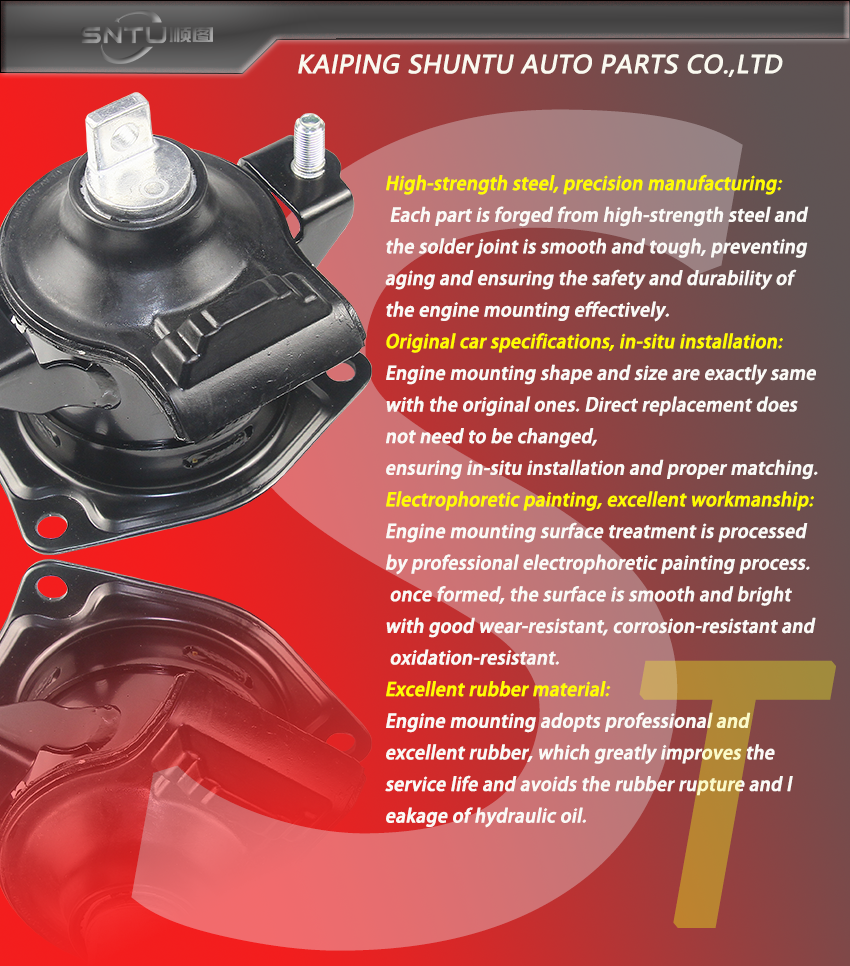
Because hydraulic mounts involve fluid sealing and complex internal geometry, they are significantly harder to manufacture than solid rubber parts. If the rubber seal fails, the fluid leaks out, and the mount collapses, leading to metal-on-metal contact.
When sourcing these parts, specifically for the aftermarket, it is vital to find a specialized Chassis Rubber Moulds Manufacturer that understands both the rubber formulation and the hydraulic engineering.
Companies like Kaiping Shuntu Auto Parts CO.,LTD have specialized in this niche since 1990. Located in Guangdong, China, they produce thousands of specific parts for Japanese and German brands, including Honda, Nissan, Toyota, Mazda, Ford, and BMW. Sourcing from a manufacturer with decades of experience ensures that the replacement mount mirrors the dampening characteristics of the original OEM part.
Since these mounts contain fluid, their failure modes are different from standard mounts. If you own a vehicle listed above, keep an eye out for these symptoms:
1.Purple or Oily Leaks: If you see a reddish or oily substance dripping from the side of the engine block near the chassis, the hydraulic chamber has likely ruptured.
2.Excessive Vibration at Idle: If the steering wheel shakes noticeably when you are stopped at a red light but smooths out when you accelerate, the low-frequency damping capability of the mount is gone.
3.Clunking Noises: When the fluid leaks out, the mount loses height. This can cause the engine to settle onto the metal subframe, causing a loud "clunk" when shifting gears or going over bumps.
If you are considering replacing a mount, you might be tempted to switch to a cheaper solid rubber aftermarket option. Here is why you should weigh that decision carefully.
Feature | Hydraulic Engine Mounts | Solid Rubber Mounts |
|---|---|---|
Vibration Dampening | Excellent (High and Low frequency) | Good (mostly High frequency) |
Ride Quality | Smooth, quiet, refined | Can transmit more buzz/vibration |
Cost | Higher | Lower |
Lifespan | 80,000 - 120,000 km (typically) | Can last longer, but rubber hardens over time |
Failure Mode | Fluid leak / Collapse | Cracking / Separation |
The automotive industry is constantly moving toward higher efficiency and greater comfort. Hydraulic engine mounts are a key piece of that puzzle. Whether you are driving a BMW 7 Series or a Honda Odyssey, these components work silently to isolate you from the mechanical chaos under the hood.
For businesses in the auto parts industry, recognizing the shift toward hydraulic applications is essential. Partnering with a dedicated manufacturer like Kaiping Shuntu Auto Parts allows you to provide the high-quality, engineered solutions that modern vehicles demand. When the mount is built correctly, the driver feels nothing at all—and that is exactly the point.